
Don't Make Your Intestines Do Your Teeth's Job

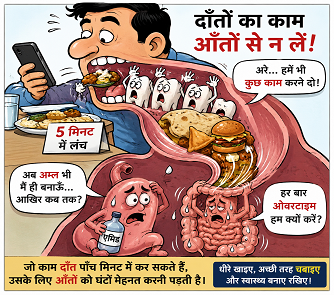
Don't Make Your Intestines Do Your Teeth's Job
In the Bengali language, if you ask someone whether they would like to drink water, you would say, "Apni ki jol khaben?" Literally, this translates to "Will you eat water?" To Hindi speakers, this sounds rather amusing because water is not something one "eats." Conversely, if someone were to say "drink your food," that too would sound equally odd. Yet this linguistic curiosity reminds us of an important fact: food is meant to be chewed thoroughly before it is swallowed.
Health experts generally advise chewing each mouthful of food at least 25 to 30 times so that it becomes soft and almost liquid before reaching the stomach. However, in today's fast-paced lifestyle, most people swallow their meals in haste, leaving the intestines to do the work that actually belongs to the teeth. This is one of the reasons why indigestion, acidity, constipation, bloating, and other digestive disorders have become increasingly common.
The Intestines: A Vital Part of Digestion
The intestines are among the most important organs of our digestive system. While our teeth break down food mechanically, the intestines absorb nutrients that nourish the body. The human body is wonderfully designed, with each organ assigned a specific function. Eyes are meant for seeing, ears for hearing, the heart for pumping blood, and teeth for chewing food.
Unfortunately, many people neglect their dental health. Proper oral care is important, but equally important is using the teeth as nature intended—by chewing food thoroughly. Healthy teeth contribute not only to a beautiful smile but also to efficient digestion.
The Mouth: The First Laboratory of Digestion
Most people believe that digestion begins in the stomach and that the intestines alone are responsible for digesting food. In reality, digestion starts in the mouth.
The teeth break food into small pieces while saliva mixes with it. Saliva contains enzymes that begin digesting starch even before food reaches the stomach. When food is not chewed properly, both the stomach and intestines must work much harder to digest it.
Shifting the Burden from Teeth to Intestines
Imagine feeding large stones into a machine instead of properly crushed material. The machine would be forced to work much harder. The same principle applies to our digestive system.
When poorly chewed food reaches the stomach, the stomach must produce more acid to break it down. The intestines then have to make extra effort to process it further. Over time, this can result in indigestion, gas, bloating, constipation, and poor absorption of nutrients.
Lifestyle and Daily Habits Matter
Eating while scrolling through a mobile phone, watching television during meals, finishing lunch within five or ten minutes at the office, or gulping down fast food without chewing properly—these habits prevent the teeth from performing their natural function.
Today, many people simply swallow food instead of chewing it adequately. As a result, the stomach is forced to perform a task that actually belongs to the teeth.
Give Every Bite the Time It Deserves
Dentists recommend chewing every bite approximately 25 to 30 times. Although the exact number may vary depending on the type of food, the guiding principle remains the same: chew until the food becomes soft, almost paste-like, and well mixed with saliva.
The more thoroughly we chew, the more saliva is produced, making digestion smoother and more efficient.
The Risks of Eating Too Fast
People who finish an entire meal within five to ten minutes often consume more food than they actually need. The brain takes nearly twenty minutes to receive the signal that the stomach is full. Fast eaters continue eating before this signal arrives, resulting in overeating.
This habit can increase the risk of obesity, diabetes, and cardiovascular diseases.
Especially Important for Older Adults
As people grow older, their teeth naturally weaken, and many require dentures or other dental prostheses. Under such circumstances, chewing food thoroughly becomes even more important.
If dental problems exist, they should be treated rather than simply switching to soft foods. Proper chewing remains an essential part of healthy digestion regardless of age.
Teach Children Healthy Eating Habits
The growing popularity of junk food and packaged snacks has also affected children's eating habits. Many children eat hurriedly without chewing properly.
If they are taught from an early age to chew food thoroughly, they are likely to enjoy better digestion throughout their lives. It is equally important to keep mobile phones and television away during mealtimes.
Unfortunately, many young children today become addicted to mobile screens, often because parents use them to persuade children to eat or drink milk. This practice should be avoided, as mindful eating is essential for healthy digestion.
Healthy Teeth Are Essential
Without healthy teeth, proper chewing is impossible. Therefore, brushing twice a day, undergoing regular dental check-ups, limiting sugary foods, and maintaining good oral hygiene are all essential practices.
Healthy teeth are not only the key to a beautiful smile but also the foundation of a healthy digestive system.
Nature's Message
Observe cows, buffaloes, camels, and other herbivorous animals. They spend hours chewing their food. Nature has given human beings teeth for the same purpose—to chew food thoroughly before swallowing it.
When we ignore this natural process, we place unnecessary stress on our digestive system.
Today, we often discuss advanced medical treatments, expensive medicines, and nutritional supplements. Yet we frequently overlook one of the simplest and most effective rules of good health: chew your food properly.
If we allow our teeth to do the work they were designed to do instead of forcing our intestines to compensate, many digestive problems can be prevented without medication.
So, eat slowly, chew thoroughly, and never make your intestines do your teeth's job. This simple habit can lay a strong foundation for a healthier, more energetic, and disease-free life for years to come.
If you plan to submit this article to an international magazine or newspaper, I can also Adapt the article into a more journalistic, feature-style English article with a stronger opening and a more engaging narrative flow.












 राष्ट्रीय सुरक्षा सलाहकार अजीत डोभाल को बड़ा सम्मान, 1 अगस्त को मिलेगा लोकमान्य तिलक पुरस्कार
 ब्रिटेन में सत्ता परिवर्तन, एंडी बर्नहैम बने नए प्रधानमंत्री; कीर स्टार्मर ने छोड़ा पद
 मानवता की कीमत जान से चुकाई, बछड़े को बचाने कुएं में उतरे चार युवकों की मौत
 शिप इंजीनियर रोहन की मौत से गांव में शोक, ईरान हमले ने छीनी एक और भारतीय की जान
 कैलारस शक्कर कारखाने के मुद्दे पर जौरा विधायक पंकज उपाध्याय का विधानसभा परिसर में धरना