
Homeopathy Shows Sustained Relief in Allergic Rhinitis: AIIMS Bhopal Study

Homeopathy Shows Sustained Relief in Allergic Rhinitis: AIIMS Bhopal Study
Allergic rhinitis is a common long-term condition that affects millions of people worldwide and causes repeated sneezing, runny or blocked nose, and disturbed sleep, leading to reduced quality of life. In this context, AIIMS Bhopal’s a new clinical study highlights the role of homeopathy in providing relief in allergic rhinitis.
This randomized, open-label, controlled clinical trial was conducted at AIIMS Bhopal by the Department of AYUSH (Homeopathy) in collaboration with the Department of ENT. The study was led by Dr Ashish Kumar Dixit (Homeopathy) and Dr Anjan Kumar Sahoo (ENT), with key contributions from Dr Shaila Sidam (ENT) and Dr Nibha Giri (Homeopathy). A total of 210 adult patients with moderate to severe allergic rhinitis participated in the study.
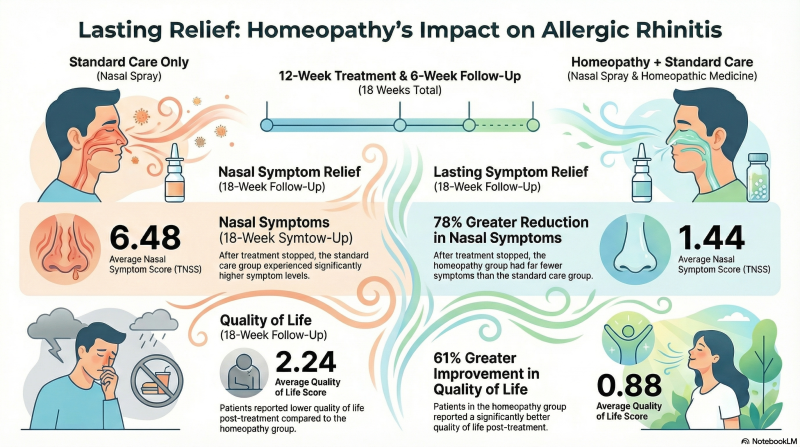
Participants were divided into two groups: one group received standard treatment with fluticasone furoate alone, while the other group received fluticasone furoate along with individualised homeopathic medicine. Treatment was given for 12 weeks, and patients were then followed for an additional 6 weeks without treatment, making the total study duration 18 weeks.
The results showed that during the active treatment period (at 4 and 12 weeks), both groups experienced similar improvement in nasal symptoms. At 18 weeks, patients who received homeopathy in addition to standard care demonstrated significantly better sustained outcomes. The Total Nasal Symptom Score (TNSS) was 1.44 in the homeopathy group compared to 6.48 in the standard-care-only group, representing an approximately 78% better reduction in nasal symptoms compared to standard-care-only group. Similarly, quality of life was markedly better in the homeopathy group (0.88) compared to the standard-care group (2.24), indicating a 61% improvement. This study has been published in a prestigious international journal.
In conclusion, this study provides clinical evidence that Homeopathy can offer sustained benefits in allergic rhinitis when used as an adjunct to conventional therapy, particularly by reducing symptom recurrence over time.















 राशिफल 05 जुलाई 2026: जानिए आज का दिन आपके लिए कैसा रहेगा
 21वें कल्याण महाकुंभ में उमड़ा आस्था का सैलाब,
 मानवता की प्रेरक मिसाल: एम्स भोपाल में 97 वर्षीय शिक्षाविद् श्री राजेश्वर प्रसाद माहेश्वरी का देहदान
 प्याज उत्पादक किसानों को बड़ी राहत
 हर्ष फायरिंग की कीमत: जश्न की गोली ने ली जान, BJP विधायक को मिली सजा