Impartiality of Investigative Agencies Is Essential for Democracy!....................... Dr. Chander Sonane

Impartiality of Investigative Agencies Is Essential for Democracy!
Dr. Chander Sonane
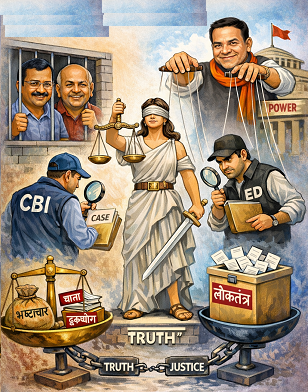
Recently, a special CBI court in Delhi discharged former Delhi Chief Minister Mr. Arvind Kejriwal, former Deputy Chief Minister Mr. Manish Sisodia, and all other accused even before charges could be formally framed. In connection with the excise policy of the Arvind Kejriwal government in Delhi, the CBI had kept Mr. Kejriwal in jail for 176 days and Mr. Sisodia for 530 days. The very case for which they remained imprisoned was considered by the court as not even fit for framing of charges.
Justice Mr. Jitendra Singh of the special CBI court observed in this regard that a public servant had been made an accused without evidence, and that the conduct of the investigating officer should be examined. The court stated that legally there was no material available to create grave suspicion. It further observed that dragging the accused into a criminal trial without admissible evidence would amount to misuse of justice and abuse of the criminal process.
The said decision of the special CBI court makes it clear that whether it is the CBI or any other investigative agency, impartiality is essential for democracy. Generally, those in power have been misusing investigative agencies to topple opposition governments and malign them.
Irrespective of which party is in power in the country, governments have historically used investigative agencies to defame opposition-led governments. This has a long history. During the tenure of Prime Minister Indira Gandhi, investigative agencies, including the CBI, were widely misused. The present BJP government is not different from the Congress in this matter; rather, it appears to be several steps ahead.
Whether at the state or central level, a strong opposition is essential for democracy. If the opposition is capable and effective, it can keep the government in check and prevent it from making wrong decisions. However, this does not seem to be happening now, which poses a threat to democracy.
In the case related to Delhi’s liquor policy, after a prolonged investigation, arrests, and political accusations and counter-accusations, when courts grant relief to several accused or question the weakness of evidence, the debate does not remain confined to one case alone. It transforms into a larger question: Are allegations themselves becoming a form of punishment in Indian politics? The action, imprisonment, and recent judicial relief granted to leaders like former Chief Minister Mr. Arvind Kejriwal and Deputy Chief Minister Mr. Manish Sisodia have once again raised the fundamental question—where is the balance between investigative agencies, judicial process, and political narrative?
Ultimately, this debate is not about the victory or defeat of any one political party. It is about democratic balance—where agencies remain independent, politics remains accountable, and the judicial process is time-bound. Allegations may be necessary, but the strength of democracy lies in ensuring that the final truth is determined not by accusations, but by evidence and judicial conclusions.
India’s democracy has witnessed many ups and downs. Time bears witness to this. Everything is eventually accounted for. In the interest of the nation’s democracy, it is essential that all investigative agencies remain impartial and function within their defined limits. Only then can democracy truly survive.

Dr. Chandar Sonane, after retiring from the post of Joint Director in the Madhya Pradesh Public Relations Department, resides in Ujjain. He has a keen interest in contemporary and social issues and candidly expresses his views on matters of public interest through the “Sarokar” column.



 राशिफल 05 जुलाई 2026: जानिए आज का दिन आपके लिए कैसा रहेगा
 21वें कल्याण महाकुंभ में उमड़ा आस्था का सैलाब,
 मानवता की प्रेरक मिसाल: एम्स भोपाल में 97 वर्षीय शिक्षाविद् श्री राजेश्वर प्रसाद माहेश्वरी का देहदान
 प्याज उत्पादक किसानों को बड़ी राहत
 हर्ष फायरिंग की कीमत: जश्न की गोली ने ली जान, BJP विधायक को मिली सजा